What Makes It Great? with Rob Kapilow
Songs from My Fair Lady, Camelot, and Brigadoon: Lerner & Loewe’s Greatest Hits
Saturday, January 17
NEC's Jordan Hall
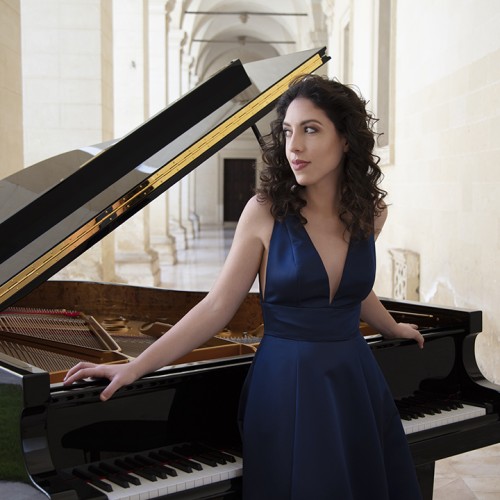
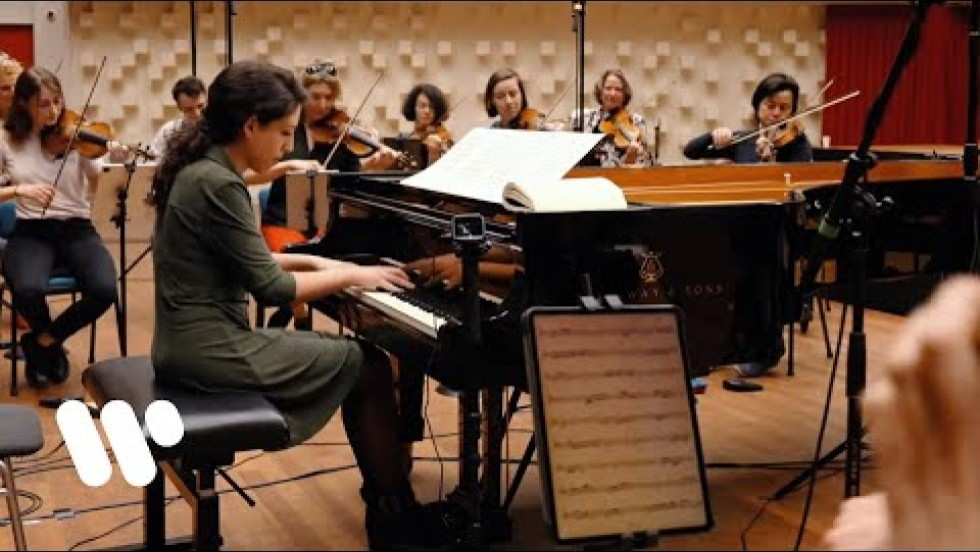
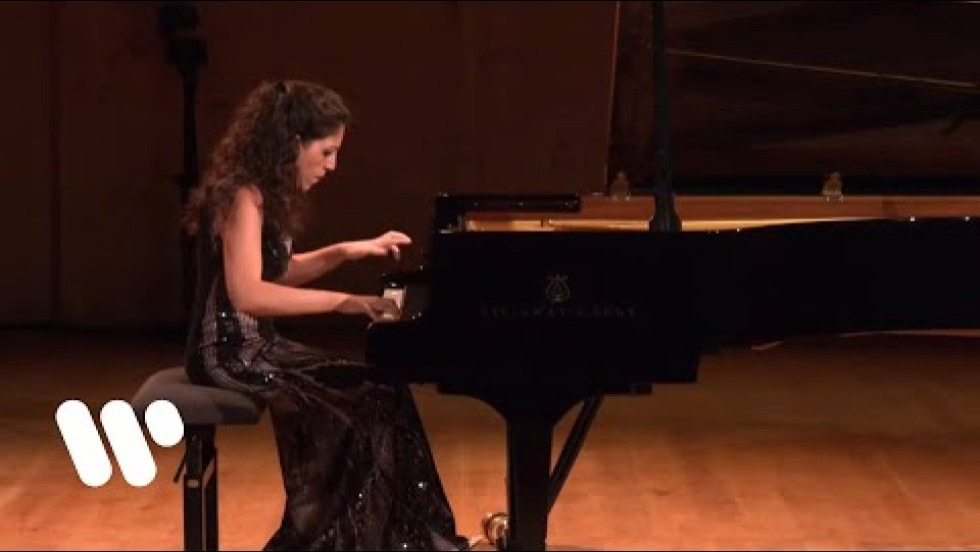
Called “a marvelously expressive interpreter with a keen sense of how to get to the emotional heart of a work” by Minnesota’s Star-Tribune, Beatrice Rana returns to Celebrity Series with a program that shows off her refinement and virtuosity. She brings her storytelling prowess and emotional expressiveness to two well-loved ballet suites: highlights from Prokofiev’s Romeo and Juliet, and selections from Tchaikovsky’s Nutcracker suite.
Debussy’s Études require deft hands and a sensitive, poetic touch: Rana will bring them to vibrant life on stage. The first of Prokofiev’s mighty “War Sonatas,” composed early in the Second World War, closes the program with a palette of moods that range from fiery and forceful to haunting and atmospheric.
Beatrice Rana delivers it all, from the "Dance of the Sugar Plum Fairy" to armies on the march. She will leave you awestruck.
“The remarkable pianist Beatrice Rana is an artist of truly reflective grace … combining poetry and great skill, among the most gifted musicians of her generation.”
Gramophone
Mendelssohn, Schumann, Liszt, Verdi, and Strauss are only a few of the composers who were inspired by the plays of Shakespeare. Shakespeare’s Romeo and Juliet became the subject of works by composers as diverse as Berlioz, Bellini, Gounod, Tchaikovsky, Delius, and Bernstein. The first ballet based on the story of Romeo and Juliet was performed in 1811, in Copenhagen. In the autumn of 1934, the managers of the Leningrad Opera and Ballet Theater proposed that Prokofiev write a ballet for them on the same subject. The Bolshoi Ballet in Moscow was interested too, and the project caught fire in Prokofiev’s creative imagination.
In the spring of 1935, Prokofiev worked on the scenario with the ballet company directors, and by the end of May, he was showing other composers sketches for the music. The whole work was so clear in his mind, so meticulously planned out, that he was able to write the complete score for this full-evening-length three-act ballet between July 1 and September 8, 1935, while also composing his second violin concerto and a number of other works.
When Prokofiev committed his musical invention to this story of tragic love, his music was able to create and illuminate the complete drama, choreographically, describing the setting and probing the characters. The story of the ballet follows Shakespeare’s play closely, although at one point in the planning, Prokofiev and his collaborators considered changing the ending to a happy one.
The Bolshoi Company considered the score in October 1935, but made no plans for a stage production in Russia; consequently, the first performance of the ballet was in Brno, Czechoslovakia, in 1938. When he understood that the ballet would not be staged in his homeland, Prokofiev used much of the music in two suites for orchestra and also created a set of ten piano pieces based on the score. He altered the excerpts to make them more suitable for concert use, so that each became a perfect miniature. The early popularity of the suites finally led to the first Russian production of Romeo and Juliet by the Kirov Ballet in Leningrad in 1940. In March 1946, a third suite was performed for the first time, and in December 1946, the ballet entered the repertory of Moscow’s Bolshoi Ballet.
The now much-loved and very familiar music was at first described as hard and cold, but Prokofiev countered this judgment by saying, “If people find no melody and no emotion in this work, I shall be very sorry. But I feel sooner or later they will.” One critic, Israel Nestyev, noted that the music “employs the most expressive melodic images with extreme economy of timbral and harmonic embellishment. . .. It is not until one grows accustomed to this music that its amazing purity of emotion and power of conviction can be appreciated to the full.”
The ten-movement powerful, virtuosic piano music chronicles the beginning of the love between Romeo and Juliet, with some additional character and ensemble dances to fill out the background. Prokofiev selected what he felt were the parts best suited for transcription. He picked those “for which the original was playable on piano and not much, if anything, needed to be removed”; thus, the music of the Ten Pieces is virtually identical to that of the original ballet score. Nine of the ten are “taken directly from the ballet without alteration.” The significant changes are only in the order in which the various scenes transcribed for piano appear in the ballet. Of the pieces, only No. 8, “Mercutio,” comes from the two suites for orchestra. The narrative of the suites and the Ten Pieces is different, and the order of the pieces varies significantly.
Although Prokofiev compiled the transcription of these character pieces for him to play to promote the ballet, he never performed more than three movements in any one concert.
Today’s performance includes the following selections:
“The Montagues and Capulets,” a ponderous dance for the knights, initially has a martial tone. Juliet dances ceremoniously with Paris before the initial weighty dance returns, first a bit lighter but then ending heavily. Romeo spies Juliet and pursues her. It changes the mood of the music, for now Romeo and Juliet have fallen in love.
“Friar Lawrence” begins with calm tones signifying the advice Romeo receives concerning his romantic dilemma, but it is succeeded by the joking tones of "Mercutio," the following piece (see below). When Romeo enters, not knowing why his presence was sought, Lawrence does not answer immediately. Romeo persists and then Lawrence brings in the white-clad Juliet. Lawrence opens the inner doors and lets in Juliet, who embodies virginity.
In “The Young Juliet,” Juliet enters with her nursemaid; she is not eager to dress in her finery for the ball. The nursemaid nevertheless gets her into a gown. The playful music concludes with Juliet standing before a mirror and realizing, suddenly, that she is now a young woman.
“Mercutio” begins with Romeo and Juliet looking each other in the eye as Lawrence departs. Romeo and Juliet embrace while they are alone, and resume their original positions when Lawrence returns. They kneel before him, and he conducts the wedding ceremony. Mercutio’s dance, which is somewhat buffoonish, makes the gathering livelier.
©2025, Susan Halpern
Debussy created and led the French musical impressionism movement. He began the study of piano at the age of nine, entering the Paris Conservatory to study piano with Marmontel and composition with Ernest Guiraud. From 1887 on, Debussy confined his activity to composition, rarely performing piano in public. Although he associated very little with musicians, he met the leading Impressionist poets and painters frequently at gatherings at the home of the poet, Stéphane Mallarmé. The influence of these artists is apparent in Debussy’s first important orchestral work, Prelude to the Afternoon of a Faun, inspired by Mallarmé’s poem “The Afternoon of a Faun.” This work laid the foundation for the style of impressionist music and initiated Debussy’s most productive period, which lasted nearly twenty years, a period in which he composed his orchestral suites, an opera, Pelléas and Mélisande, and most of his piano music.
Debussy’s style substantially influenced 20th-century music. Even as a student, he refused to yield to the rules of traditional music theory. Later he stated, “There is no theory. You have only to listen. Pleasure is the law.” Preferring understated effects, he rejected the overblown forms and the harmonic style of the post-Wagnerians such as Mahler and Wagner. He wanted his music to sound almost improvisatory, as though it had not been written down.
In 1915, Debussy’s publisher asked him to prepare a new edition of Chopin’s Études, a job that Debussy undertook as a labor of love. That summer, in the seaside village of Pourville in Normandy, he worked feverishly on the last big projects he was to undertake before his cancer was discovered at the end of the year. He corrected the Chopin proofs and he composed two sonatas, a set of two piano pieces, and a dozen études (studies) that he dedicated to the memory of Chopin. He also seriously considered a dedication to François Couperin because the early French harpsichord school also influenced him when he wrote this music. Many composers have written a series of twelve études, but most of those études since Chopin’s have been essentially tone poems, intended for performance in public. Debussy intended his études for real exercises, though they do make fine concert pieces because they are sophisticated, highly polished, and display remarkable invention in the French style, while still dealing with the most varied technical and musical problems.
The first six of Debussy's études, known as Book 1, carry titles that state their purpose: finger exercises at various intervals. Debussy wrote the first études incorporating recent harmonic development. The six études of Book 2 are somewhat different, and their titles hint at the composer’s exercises, intellectual, aesthetic, and technical, in stretching the new century’s musical vocabulary as well as its pianists’ fingers. Debussy explains these pieces well: “I must confess that I am glad to have successfully completed a work which, I may say without vanity, will occupy a special place of its own. Apart from the question of technique, these Études will be a useful warning to pianists not to take up the musical profession unless they have remarkable hands.” Each is a musical tone poem testing what is actually a new kind of pianism based on fingertip sensitivity and finely filtered pedaling. Each presents a challenge in sonority and texture in a novel way that digital dexterity alone cannot accommodate.
No. 7. Étude pour les degrés chromatiques (for the chromatic degrees of the scale) opens Book 2. It presents passages of chromatic scalar accompaniment that playfully interrupt and then drown out the regular progress of diatonic melody. This piece contains both lyricism and brilliance.
No. 8. Pour les agréments (ornaments) has, in the words of Debussy, “the form of a Barcarolle on a rather Italian sea.” The texture evokes a kind of ‘watery’ feeling, at times reminiscent of the composer’s L’Isle joyeuse. Giulia Sereni has said that the ‘ornaments,’ which decorate this étude’s melodic lines “pay tribute to the composers of the French Baroque. The title evokes the ornamentation and technique of the clavecinistes [harpsichordists] of that time” that Debussy appreciated.
No. 9. Pour les notes répétées is marked scherzando, a mood created not only by its bubbly texture of “repeated notes” but also by the movement of its darting melodies and unpredictable changes of mood, all carried out softly. Tonality seems to be evasive because of the inclusion of both minor and major seconds and the use of tritones. The tritones make us think of Messiaen who admired the Études, commenting that they are “particularly extraordinary for their elusive formal qualities.”
No. 10. In Étude pour les sonorités opposées (contrasting sonorities), timbre or sound quality becomes a structural element and part of the content of the music, rather than just a decorative element. Roger Nichols has said that Debussy was not only initiating a new trend in music for the piano that would become a concern of pianists until the present, but he was creating a whole new “brand of pianism.”
No. 11. Étude pour les arpèges composés (composite arpeggios) shows new ways in which to use the harp-derived broken chords called arpeggios, and has a light-toned, contrasting central section based on Lisztian technique. What the composer means by the last word of the title has been much puzzled over by both performers and musicologists, but it has been conceded that that these arpeggios were put together (composed in the French sense of the word, much like a salad has its ingredients mindfully put together in a salade composée). Although Debussy includes the parts of traditional triads in his arpeggios, he also adds his often-used characteristic intervals of sevenths and ninths and other intervals.
No. 12. Étude pour les accords (chords) has been called a “barbarous dance” and it is, unquestionably, monstrously difficult and quite exciting. This final étude has a contrasting leisurely middle section, but before the end, the texture returns to that of the initial section with its acrobatic rhythms. Overall, it is a huge, complex study whose problems posed to the pianist include the massive leaping chords of the first and last sections and the important silences in the middle. E. Robert Schmitz finds it “straightforward and direct in its coloring, bringing a relief from the complexities which have previously been presented, debated, developed, serving then as a form of resolution or answer to the questions of form, melody, harmony, counterpoint, which have made great demands on intellectual processes.”
©2025, Susan Halpern
Tchaikovsky's entertaining masterpiece, The Nutcracker, is one of the most popular works ever created for the ballet. Always a favorite in theaters and concert halls, especially at Christmas, The Nutcracker vividly displays the composer's virtuosity in creating varied orchestral colors.
Early in 1891, the Saint Petersburg Opera commissioned two works from Tchaikovsky for performance as a double bill: a one-act opera called Yolanta, which is now forgotten, and the great ballet, The Nutcracker. Tchaikovsky immediately disliked the commission for The Nutcracker, but the subject was forced upon him. That March, he set out on a long trip across Western Europe, stopping to hear a concert of his own works in Berlin, conducting a concert in Paris, and then sailing to New York, where in May, he led parts of two inaugural concerts at Carnegie Hall. All during his long trip and another concert tour later that year, he worked on his commissions. Interestingly, Tchaikovsky had become acquainted with the celesta, a newly invented instrument, just before he departed for the United States. Captivated by its "divinely beautiful tone," he used it immediately, giving it great fame, in the "Dance of the Sugar Plum Fairy" in The Nutcracker.
As usual, Tchaikovsky pessimistically misjudged his own work. In letters to friends and relatives at home, he wrote that he was hurrying to get The Nutcracker ballet out of the way so that he could work on the opera, which he felt held significantly more interest as a project: "I sense a decline in my creative powers [which are] worn out," he said. Even after the first performance of the two works, on December 18, 1892, an event honored by the presence of the Czar himself, he wrote, "The success was not complete. The opera seemed to please, but not the ballet [which] turned out to be rather boring." Posterity, of course, does not agree. In the concert hall and in the theater, The Nutcracker is one of the best-loved works of the entire 19th century.
The original scenario of the ballet was planned by the great choreographer Marius Petipa and was based on the story of "The Nutcracker and the Mouse-King" by the German Romantic fantasist E.T. A. Hoffman, which Tchaikovsky had first read in 1882, in an adaptation by Alexander Dumas, Sr. Before the ballet went into production, Petipa fell ill, and the original choreography became the work of his assistant, Lev Ivanov.
Act 1 begins with a miniature "Overture," after which the curtain rises to show the tree being decorated in little Clara's house on Christmas Eve. Clara's godfather arrives and distributes his fanciful gifts to the children. Clara's present, a nutcracker, is carved in the shape of a soldier. When her brother breaks her nutcracker-soldier, she puts it in her doll's bed in hopes that it will rest and recover. Clara goes to bed and dreams of an army of mice on the point of defeating gingerbread soldiers, when the Nutcracker, miraculously mended, rises to chase the mice out. The Nutcracker is then transformed into a handsome Prince who takes Clara away through the pine forest, where the Snow Flakes dance a Waltz.
Act 2 is set in the Candy Kingdom, the domain of the Sugar Plum Fairy, where preparations are being made in the magic Castle on Sugar Mountain for the arrival of Clara and the Prince. When they enter, the Prince tells everyone that Clara saved his life, and a grand Divertissement is presented in their honor by all the sweets and "goodies" in which the characteristic dances are staged: chocolate does a Spanish dance; coffee, an Arabian dance; tea, a Chinese dance. There is a Russian dance, a trepak, and then a dance of the pennywhistles. There is a dance for a fairy-tale mother with many children, similar to the Old Woman Who Lived in a Shoe, and then the Sugar Plum Fairy's courtiers perform the beautiful "Waltz of the Flowers." The Sugar Plum Fairy and the Prince dance a beautiful pas de deux, then everyone joins in the Grand Waltz-Finale; the ballet ends with a tribute to Clara!
In this performance, you will hear the March; Dance of the Sugar Plum Fairy; and Intermezzo from Act 1, and the characteristic dance Tea (Chinese Dance) from Act 2.
©2025, Susan Halpern
Prokofiev was born in a remote Ukrainian village where his agronomist father worked as manager of a large estate and his mother gave him his first music lessons. Later he continued his musical studies at the Conservatory in St. Petersburg. Following the Russian Revolution, Prokofiev came to the United States and then settled in Paris, where he was an influential figure, until his return to Russia in 1933. When he returned to the Soviet Union, Prokofiev made a conscious, concentrated effort to make his music completely accessible to his audiences. He thought that he could modify his serious style most easily in music for the theater and films; through that music he hoped to reach a larger public. In the late 1930s and the early 1940s, he concentrated on those new genres, composing music for the ballets Romeo and Juliet (1935-36) and Cinderella (1940-44), the film Alexander Nevsky (1938), and the children's tale, Peter and the Wolf (1936).
In 1939, Prokofiev began to plan a cycle of three piano sonatas, his sixth, seventh, and eighth, and without waiting to complete and publish them, gave them opus numbers of 82, 83, and 84. He sketched themes and some development passages, working on all the sonatas almost simultaneously as if they were a single huge work and their movements almost interchangeable. He finished Sonata No. 6 in February 1940, and in April he played it for a radio broadcast. Sviatoslav Richter gave the first concert performance. The work is one of the longest, most dramatic, and most technically difficult of the composer's nine piano sonatas.
The opening figure of the hard-driving first movement, Allegro moderato, forcefully propels the music forward, and even the long passages of repeated notes do not slow its fierce motion or lessen its strenuous pressures. Yet Israel Nestyev, in his biography of Prokofiev, characterizes this movement as one lacking human emotion. Nestyev feels that cruel and terrible demonic forces are in control: "In the listener's imagination arise either archaic images of raging monsters or recollections of devestating military invasions."
The second movement, Allegretto, a complete contrast from the first, resounds with rhythmic grace. Its dance-like character brings us back to earlier Prokofiev. A completely engaging lyrical movement, it is structured in three-part form but includes some novel variations.
A very slow waltz, Tempo di valzer lentissimo, makes up the rhythm of the third movement. Appealing and romantic, the complex texture of this movement is in the character of Prokofiev's ballet music for Romeo and Juliet.
The last movement begins with the lightheartedness of the inner two movements but progresses in the finale to a recapitulation of the harsh, demonic, other-worldliness of the first movement. The exposition and development sections are happy and evoke the young Prokofiev in style, but in the final section, a dramatic change occurs, and even though the themes return, they come back without their human coloration but instead with sinister overtones. The form of the movement is a modernized rondo, Vivace, in which the rhythmic motto of the first movement reappears in several different guises. Vague recollections of other music heard earlier on in the sonata mingle with subjects, which sound like Russian folk songs.
©2025, Susan Halpern
This performance is an Aaron Richmond Recital, named in honor of Celebrity Series of Boston's founder, and endowed by his daughter Nancy Richmond Winsten and her late husband Dr. Joseph Winsten.
Songs from My Fair Lady, Camelot, and Brigadoon: Lerner & Loewe’s Greatest Hits
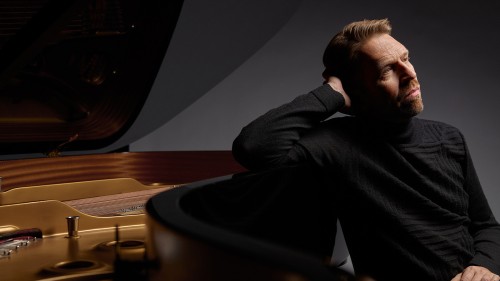
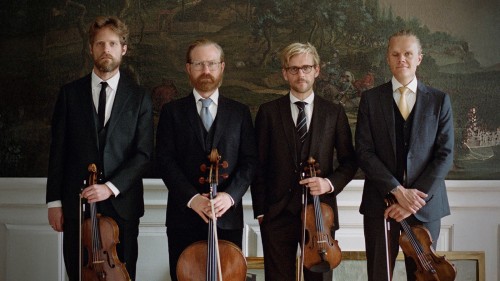

at NEC's Jordan Hall in Boston
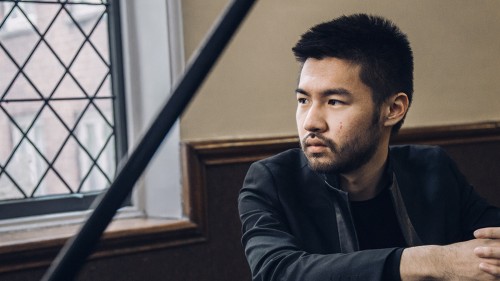
Poetry and Fairy Tales
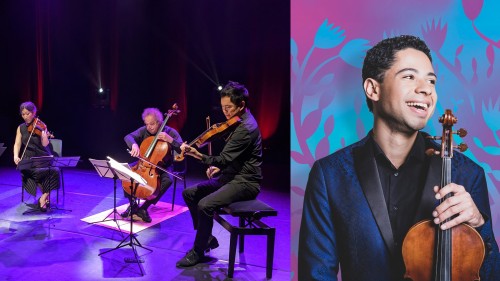
Stay in touch with Celebrity Series of Boston and get the latest.
Email Updates Sign up for Email Updates