

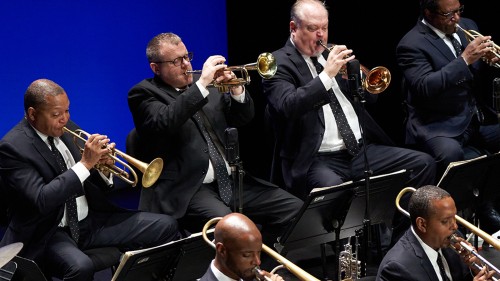
Jazz at Lincoln Center Orchestra with Wynton Marsalis (2026)
Duke in Africa
Friday, January 23
Symphony Hall
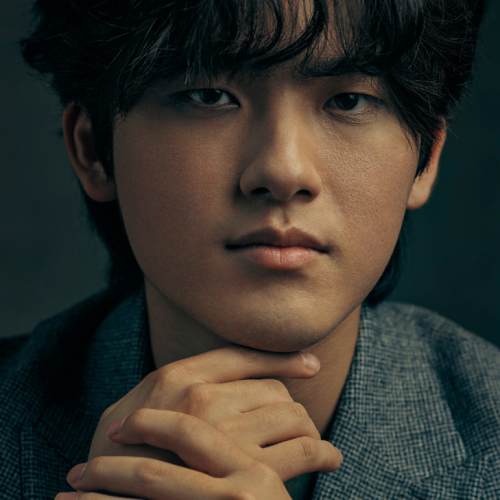
With just one concert—his stunning final-round performance of Rachmaninoff’s Third Piano Concerto to clinch the 2022 Cliburn Competition—pianist Yunchan Lim captured the classical music world’s attention. He wowed Boston audiences in 2024 with sold-out appearances at the Boston Symphony Orchestra and with the Orchestre de Paris under Klaus Mäkelä on the Celebrity Series, both in Rachmaninoff concertos.
Lim returns for his Celebrity Series solo recital debut to make a very different artistic statement. Trading an orchestra’s might for a single piano at center stage, and late Romantic passion for Baroque clarity, Lim takes on a pinnacle of the keyboard repertoire that generations of pianists have used to define and hone their artistry: Bach’s Goldberg Variations.
In Bach keyboard works, Lim “weighted the counterpoints so perfectly, and deployed such a subtle metrical flexibility, that every inner detail seemed to be imbued with a character of its own” (The Times). Don’t miss Yunchan Lim’s Celebrity Series recital debut: be amazed by a young artist who can do it all.
“Lim is only 21 now, but he plays like an old soul...his astounding, featherlight touch intertwines a pair of heartbreaking melodies, one seemingly calling out from a distance.”
Tom Huizenga NPR's All Things Considered
“A one-in-a-million talent.”
Dallas Morning News
This 2024 work for solo piano was commissioned by Yunchan Lim from Seoul-based composer Hanurij Lee (b. 2006).
Biography
Born in 2006 in Seoul, Lee Hanuri(j) graduated from Yewon School and is currently studying under composer Bae Dong-jin at the Korea National University of Arts.
His main interest lies not in expressing specific meanings or concepts through music but in exploring the inherent possibilities of instruments and the acoustic relationships between them through limited gestures.
His works have been performed (or are scheduled to be performed) by ensembles such as IEMA Ensemble(DE), Divertimento Ensemble(ITA), Ensemble Flex(DE), Ensemble Timf(KR), Project Ensemble 'O'(KR) and the Seoul Metropolitan Traditional Orchestra(KR).
Recently, he has expanded his scope of interest by collaborating with the Korean Academy of Film Arts (KAFA) on film music projects.
The composer provides this note on the work:
This newly commissioned work for piano, written for Yunchan Lim, delves into the profound interplay of contrasting forces. It unfolds in two major sections, Élégie and Rudepoema, hinting at the contrasting moods that will be explored.
Élégie, evocative of a mournful song or lament, may initially present itself with hushed, introspective melodies and delicate textures. Yet, within this stillness, seeds of energy may begin to stir, hinting at the Rudepoema to come.
Rudepoema, a term suggesting a raw, unrefined poem, might unleash a more forceful, dynamic energy. This section may feature driving rhythms, bold harmonies, and perhaps even moments of explosive intensity. However, echoes of the Élégie may linger, creating a dialogue between the contrasting elements.
Crucially, these two sections are not rigidly defined. They intertwine and evolve organically throughout the piece. Gentle passages may erupt into moments of raw power, while moments of intensity may subside into introspective contemplation. This dynamic interplay creates a captivating tapestry of sounds, inviting the listener on a journey through a richly nuanced sonic landscape.
This piece, in its exploration of contrasting forces, offers a unique counterpoint to the intellectual and intricate architecture of Bach’s Goldberg Variations. While Bach’s masterpiece demonstrates the pinnacle of order and meticulous craftsmanship, this new work embraces a more fluid, organic approach, celebrating the beauty of both stillness and movement, gentleness and rawness.
—Hanurij Lee
There are a handful of works whose nicknames conjure emotions of intellectual wonder, visceral excitement, joyful adoration, and the comfort of an old friendship, like Tchaik 5, Hammerklavier, Winter Wind, and the Goldbergs. Memorably, the Goldberg Variations became culturally iconic in 1955, when a young, eccentric, Canadian pianist named Glenn Gould stepped into the recording studio and made a now legendary recording of the work (Pablo Casals did something similar for Bach’s Six Suites for Solo Cello in 1936). Since then, they have been recorded hundreds of times. Far from being redundant, each new rendition recaptures the imagination with seemingly endless nooks and crannies for exploration. Like the dialogue of a fiercely witty movie, the interplay of relationships between the notes and variations reveal themselves on a deeper level with every listen—aptly described in an NPR story as a “Rubik’s Cube of invention and architecture.” There are even inside jokes, if you know them (and you will, by the end of this annotation).
Aria mit verschiedenen Veränderungen, “Aria with Diverse Variations,” was the original title for BWV 988. The nickname Goldberg comes from a story that might be apocryphal, but merits re-telling. It originated in 1802 with Bach’s first biographer, Johann Nikolaus Forkel, who related an anecdote about Johann Gottlieb Goldberg, a virtuoso harpsichordist who studied with the Bach family:
The Count [Hermann Karl von Keyserling] was often sickly, and then had sleepless nights. At these times Goldberg, who lived in the house with him, had to pass the night in an adjoining room to play something when the Count could not sleep. The Count once said to Bach that he should like to have some clavier pieces for his Goldberg, which should be of such a soft and somewhat lively character that he might be a little cheered up by them on his sleepless nights.
Thus, so the story goes, Bach wrote the Goldberg Variations.
More likely, Bach wrote the Goldbergs as the culmination to his Clavier-Übung (“Keyboard Exercise”), a collection of harpsichord and organ works published in four volumes from 1731-1741. Part I included the six Partitas, Part II consisted of the Italian Concerto and the Overture after the French Manner, Part III is a master compendium of organ works, and Part IV is the Goldberg Variations. As a whole, the Clavier-Übung traverses every style and skill set a keyboardist would need to know.
The opening theme in the Aria owes its harmonic underpinnings to one of Bach’s contemporaries whom he admired greatly: George Frideric Handel. A side-by-side comparison of Handel’s Chaconne with 62 Variations (HWV 442) reveals an identical base line in the first eight bars of both works. One of the marvels of the Goldberg Variations is the elegant symmetry of its entire construction. The thirty variations are divided into two sections of fifteen: Nos. 1-15, and Nos. 16-30. Including the Aria that appears both at the outset and the conclusion, the Goldbergs consist of thirty-two parts total. This macrostructure is reflected in the microstructure of each variation, most of which are either 16 or 32 measures in length. There are only three minor key variations, the first being No. 15—the last variation of the first part. Variation No. 16 is marked “Overture” to herald the beginning of the second half. Every third variation is a canon at an increasing interval (i.e. No. 3 is a canon at the unison, No. 6 a canon at the second, No. 9 a canon at the third, etc.), up to a ninth in canon No. 27. Playing with our expectations, Bach chooses to skip a canon at the tenth in variation No. 30 and instead offers a Quodlibet (“what pleases”), which is a mashup of counterpoint and popular tunes. Here, toward the end of this lengthy musical journey, is where Bach’s sense of humor shows most prominently. With a knowing wink, the Quodlibet includes well-known songs from Bach’s day with the words, “I have been away so long from you” and “Cabbage and turnips have driven me away (had my mother cooked meat, I’d have opted to stay).”
After meandering through all the musical possibilities, staying almost entirely in the major mode and home key of G, the variations come to an end, and return home to the Aria once again.
© Kathryn J. Bacasmot, 2025
Bach | Keyboard Concerto No. 5 in F minor, 2nd movement Arioso, BWV 1056
Duke in Africa
In the Fiddler’s House
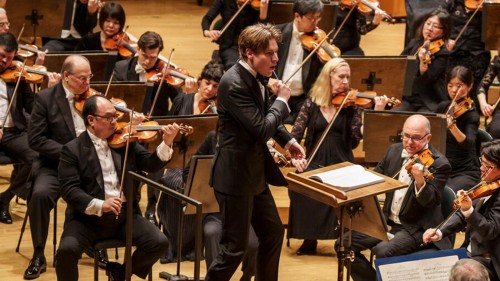
Klaus Mäkelä, Zell Music Director Designate
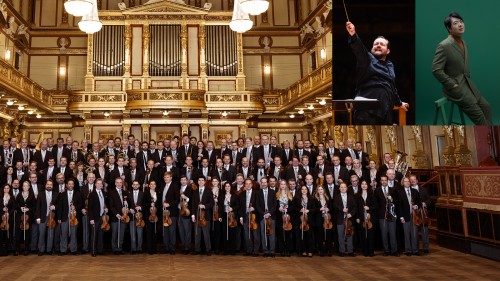
Andris Nelsons, conductor
Stay in touch with Celebrity Series of Boston and get the latest.
Email Updates Sign up for Email Updates